Thursday, October 11, 2007


Celestine Labat at 100.
Lori Gordon is a mixed media artist and writer on the arts who grew up in the Northern Plains. She began moving west and south as a teen, spending years in the Black Hills of South Dakota and the high desert of Arizona. Along the way, she picked up a bachelor's degree in political science and a master's degree in religious studies, all the while pursuing her love of art. Largely self taught, Gordon works in many medias including graphite, acrylic, handmade paper, fabric and polymer clay. Her work may be found in galleries along the Gulf Coast, in museums in South Dakota, and in public and private collections around the country. Recently, one of her pieces was acquired by the Smithsonian Institution for inclusion into their permanent collection.

In 2003 Gordon began capturing the local landscapes of her beloved Mississippi Gulf Coast in acrylic, and continued that work until Hurricane Katrina upended her life on August 29, 2005. With her home, studio and all of her supplies washed away by the 35 foot storm surge and 150 mile per hour winds which obliterated her community, Gordon returned to work using the only materials which were available to her. Five weeks after the event, Gordon began collecting rubble and transforming it into works of art.

“The Katrina Collection” is the name she has given to this new series of mixed media collages and assemblages. The series first garnered national attention when MSNBC.COM featured the work in their series “Rising From Ruin.” National Public Radio featured The Katrina Collection on their program "All Things Considered", and her work was also covered by the Associated Press. Since then, Gordon has exhibited The Katrina Collection in venues around the nation.

To see more of Gordon's work, please click on the links located on the upper right section of this page. To watch a 20-minute film on Gordon and her work, scroll down.

Film on the Work of Lori K. Gordon

This is a twenty minute film on the Work of Lori K. Gordon. It focuses on The Katrina Collection and The Labat Project.

Tuesday, August 21, 2007

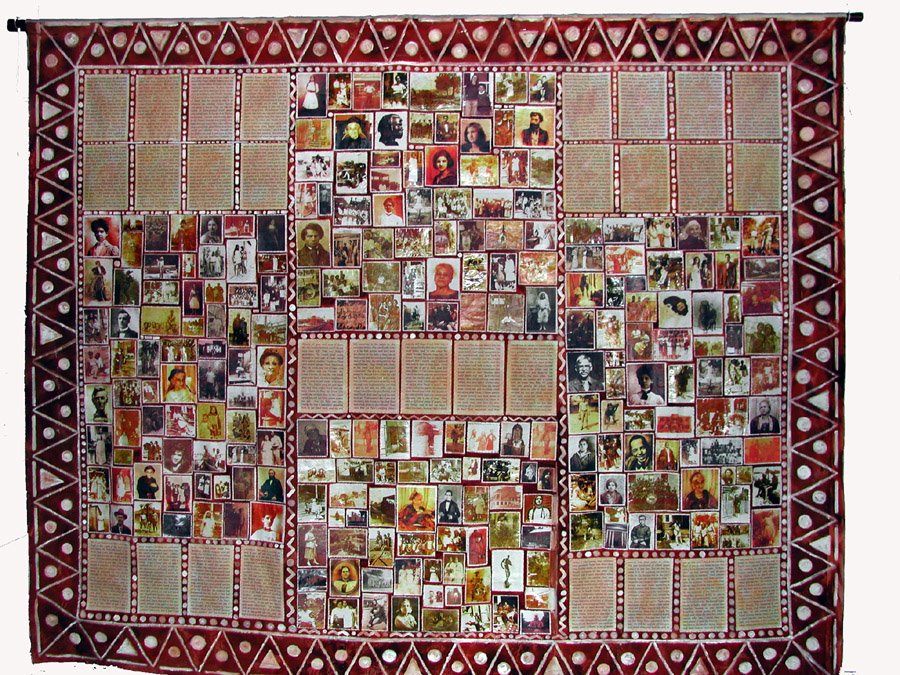
The Labat Project by Lori K. Gordon is an intensive look into the history of the Creole community of Bay St. Louis, Mississippi. The project explores the lives of the Labat family, Creole pioneers in the community, and has been set up in two phases. The first stage, an 8’ x 10’ fabric collage titled “Labat: A Creole Legacy” was completed in 2003, and has since been acquired by the Smithsonian Institution for inclusion into their permanent collection. The second phase of the project, a multi-media traveling exhibit, is currently in the planning stages.


For more information on The Labat Project, please contact Lori Gordon at lorikgordon@gmail.com.

Wednesday, October 11, 2006

Many friends and colleagues gathered to celebrate the acquisition of “Labat: A Creole Legacy” by the Smithsonian Institution. We were also celebrating the life of the person who inspired the whole project. The following is an article I wrote for a local newspaper on the occasion of the send off party for the piece.

Celestine Vivian “Teenie” Labat was a friend of mine for altogether too short of a time. She had blessed this planet with her presence for 102 years when I met her, and she brought grace to the next two years of my life. The things I learned from her about graciousness, dignity and the importance of a sense of humor will be with me for the rest of my days.

Celestine was born into a world which few of us today can even imagine. As a Creole living in the Deep South, she and her family often found themselves caught between two worlds. Surrounded by a racist society which branded any person with African heritage as inferior, she lived amidst a family of exemplary individuals. Growing up during the time when women were not allowed the right to vote, Celestine expanded her horizons to get an advanced education, attaining both a bachelor’s and a master’s degree. Segregated by the church to which her family was devoted, she lived to see that church become a beacon in the Catholic community to persons of all colors.

As I was getting to know this remarkable woman, she told me stories of her life. My experiences as a white girl growing up in South Dakota in no way prepared me for the stories which I was hearing. Celestine was a gifted storyteller and she soon had me seeing visions. I was in the yard with Celestine when, at the age of 8, she saw her white Creole grandfather staring at her. I watched along with her as her father, “Papa Joe”, won waltzing contests at the Promote Hall. I witnessed her sister Inez, an educator and principal in New Orleans, being made to sit in the back of the bus on her visits home.

In this world, I helped Celestine to rake her yard, and I worked with her to clean the graves of her siblings. I was even privileged enough to be asked to help her make her famous pecan cake. She was no longer physically able to stir the batter, but she was plenty sharp enough to see that I was not sifting the flour correctly. I wrote letters to her and called her when I was out of town, and was happy every time I heard her say “Hello” in that musical, lilting voice.

Celestine was very proud of her family, and she loved to tell stories about them. As she wove her magic in words and began showing me the faces of her people, the idea for the fabric collage project was born. Over the next year, I recorded most of my visits with Celestine. She loaned me her family photograph albums and I scanned the photos into my computer. I manipulated the images with an arts program and transformed the old black and white photos into sepia tone images that resembled paintings. I kept many of the images clear so the persons could be easily identified. Others, I allowed to become obscure. I wanted to not only present her family, but also to suggest the many contemporaries and community members whose names are now forgotten. I wanted the piece to be not only a family history, but a cultural commentary as well.

With the images in place on the collage, I began selecting the stories I wanted to include. I created the cloth “pages” of text on my computer as well, and decided to arrange the text into five general areas. In one area I presented Celestine’s personal story, and in another I told her family stories. In the third area I told her stories about living with racism, and in the fourth I presented the important place that religion held in their lives. The fifth section of the collage centered on cultural stories. When these elements were in place, my remaining task was to come up with a painted design which would pull the whole piece together and provide a border. I chose an African mudcloth design to represent Celestine’s African and Choctaw heritage. Both of these cultures favored the use of strong geometric designs in their art.

I finished the collage shortly before Celestine’s death. My good friend Ellis Anderson and Celestine’s great nephew Wesley helped me haul it into her bedroom. Ellis and I stood on chairs to hold it up for her to see. Celestine was thrilled with the collage, and talked of how it was such a wonderful testament to her family. There was laughter and joy in that room, as well as a few tears shed. I made a promise to Celestine that day; I told her that I was going to do my best to see the collage end up in a public place, so that her story could be told.

Celestine died less than two weeks later. Before her death, she told me that her great epiphany in life had happened to her in the twilight of her days on earth. She felt a deep satisfaction that the color of a person’s skin no longer meant what it had for many of the years of her life. She said that as a young person, she never would have dreamed of seeing the day when she would have so many friends of all races. I feel incredibly fortunate that she counted me as one of those friends.

And so the stories of Celestine’s life will be traveling to their new home in our country’s national museum. As I looked around at the people who gathered to bid the collage farewell, I reflected upon how happy I was to be able to fulfill the promise I had made to her. I also felt a profound appreciation for the support and encouragement I had received from so many friends along the way. Without that support, I knew that there would not have been an occasion to celebrate. I know that Celestine would be joining me in expressing our thanks to all of you.


Valena C. Jones

Louie Piernas, contemporary of Joseph Labat.

Inez Labat, Celestine's sister.

Celestine Labat at 8.

The Labat Project began with an invitation from a friend to attend a luncheon of the Hancock County Historical Society, where the speaker was to be a 102 year old woman. I attended the luncheon, and got my first sight of the most incredible human being I have ever met. Completely captivated by the grace, composure and presence of Ms. Celestine Labat, I went home and immediately began making phone calls in order to arrange an introduction. Later that week, I made what was to be the first of many visits to her family home.

As our friendship developed, Ms. Labat began telling me stories of her life, and graciously allowed me to take dozens of photographs. I began doing portraits of her in both pencil and acrylic, and I also started recording her stories on audio cassettes. After a time, Ms. Labat brought out her family photograph albums, and as I began putting the faces with the stories, the idea for “Labat, A Creole Legacy” was born.

Over the next year and a half, I continued taping Ms. Labat’s stories, and began the long process of transcribing the tapes. I scanned her photos into my computer, digitally manipulated them, and printed them out on specialty paper. The resulting images were then transferred to cloth, and each one was individually hand hemmed and hand sewn on to a backing cloth. The same process was used with selected stories, and the 274 pieces were then secured onto a canvas support which I painted with geometric designs that echo the artistic traditions of both African and Native American cultures. After 1300 hours of effort the collage came together with a finished size of 7 ½ x 9 ½ feet.